
Last month saw the return of The Gin To My Tonic in Liverpool and I took the train journey across from Manchester to see if there was anything of interest for the website. I think its fair to say that I wasn’t disappointed and there were definitely a few gins that I came across that stood out and deserve to be highlighted for various reasons.
The first of these to be reviewed here on Manchester Food Tourist, is a Scottish gin from Crossbill Distilling. I have previously heard some good things about their gin and I was intrigued to find out more when I spotted them in the busy exhibition hall.

Now I am always interested in what unique botanical various gin makers use in their distillation and how they effect the final aromas and palette of the gin, its complexity and its finish. I also often hear from the makers themselves at how much trial and error goes into their research, before finally hitting on the final recipe.
So when I hear that Crossbill uses just two botanicals, I’m a little bit taken a back. Their original gin uses just Juniper and Rosehip, which seems strange. Crossbill is named after Scottish Bird, which is part of the finch family and is found in the highlands, which is also where the Juniper for the spirit is hand picked, as are the rose hips.
I crossed the hall to try it for myself and I cant help but overhear them trying to explain what Sumac is. This peaks my interest further!

Sumac is an ingredient I have used for many years and is a flavour I am very fond of. Found in many Middle Eastern recipes, it is made by crushing the berries of the Sumac Tree. Deep red in colour, it has a citrus flavour which is a little sour and acidic, a little like lemon juice. You may even have had it yourself without realising, as it’s often sprinkled on the top a bowl of humus in a restaurant.
As I listen to the conversation I become aware that its because the have also produced a Sumac Gin, which again uses just two ingredients – Juniper and Sumac, the later of which is both distilled with and also added in the form of infused water at the end to produce reddish orange colour to the gin.

Now Sumac isn’t something you find in the highlands, so where’s the link? Interestingly I’m told that the Scottish Crossbill has a North American Cousin which resides in New Hampshire. It’s this link that led them to research what botanicals could be found in the home of the Scottish Crossbills Cousin. Foragers there rave about Sumac and its great flavour, which is also said to be used to make a kind of pink lemonade in the region.
My excitement to try it clearly shows and I am poured a sample to try. The sample resembles a rose wine in colour, the aroma is light and clean, with the juniper appearing young and fresh and accompanied by all I can describe as a lemon sorbet.
Neat on the palatte it’s surprisingly refreshing and full bodied, partly due to it being 46% abv. Juniper flavour is met with sharp citrus like elements with a finish that is almost liquorice like, despite there being no botanicals used that would usually bring that element.
This small taste already has me asking so many questions, for example, how do they create such a deep and complex flavour without the use of other botanicals, especially those used as a kind of binding ingredient such as orris root, which is known as a fixative that helps keep the other flavours locked in.

The secret I’m told is a long and slow maceration process, which maximises the flavour and aroma properties of both the botanicals.
I’m truely intrigued and feel that I need to experiment with it further and so when back home I set about trying the sample bottle that Stuart kindly gave me in exchange for my feedback.
I try it again neat and I’m still getting a much more complex gin than I ever anticipated with just two botanicals. It’s clearly that the Sumac is coming through in various ways.
The juniper is far from subtle but seems to have an extra freshness about it, just as I remembered in the first taste, when speaking to Stuart I’m told this is because of the freshness of the ingredients used, combined with the slow maceration. As the initial flavours dissipate that lemony, slightly sherbet element comes through, surprisingly I also experienced a little white pepper like spice.

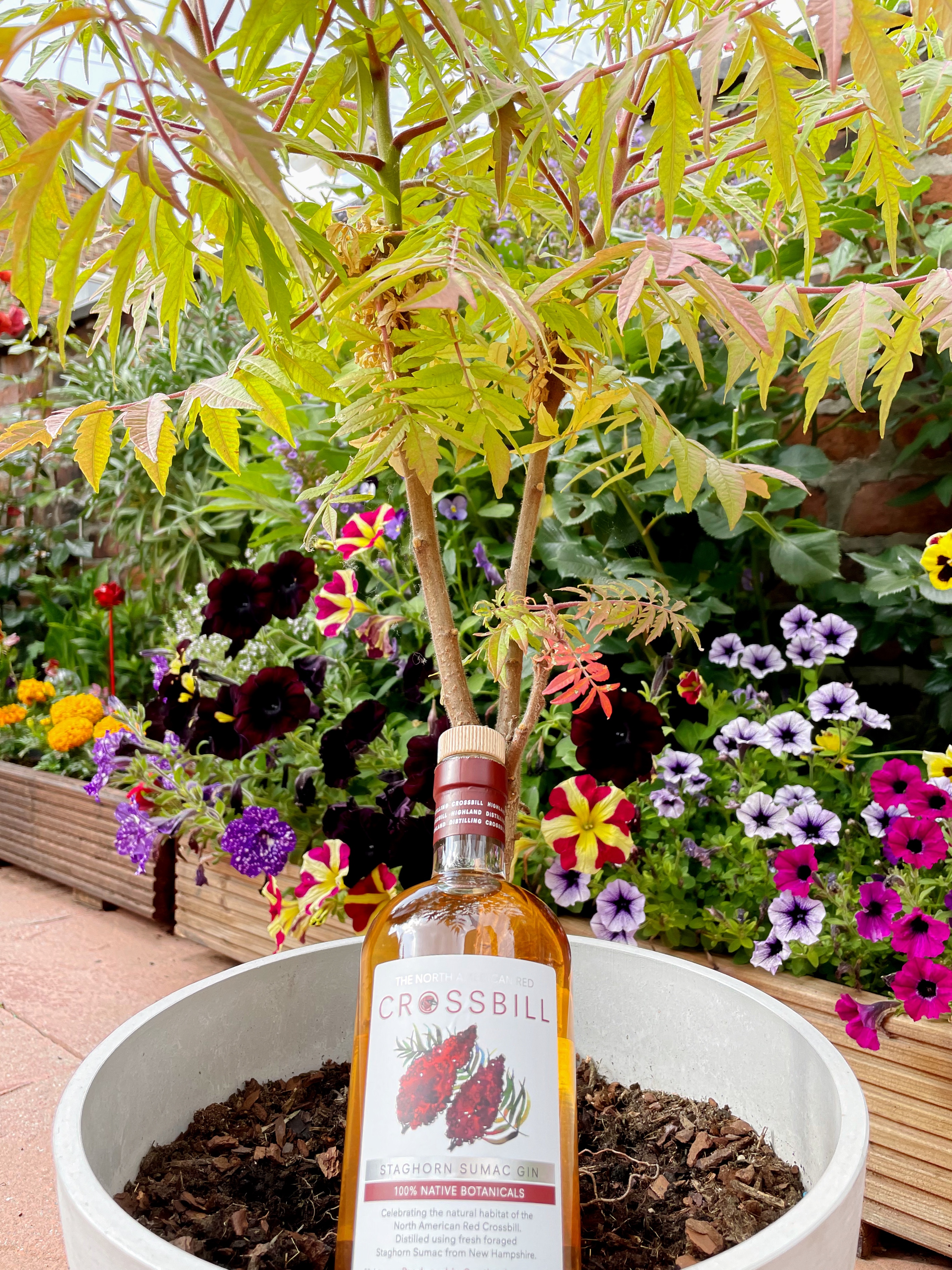
I pour a G&T using 50ml of gin with 150ml of light tonic. The juniper starts to sing. On the palette it is so light and easy drinking and I can see this being a big hit for those that like a citrus gin. It’s a million miles away from the deep spicy gins that I usually gravitate towards, yet I find myself thoroughly enjoying how simple and carefree this gin is while sitting in the garden also enjoying the appearance of my very own sumac tree, which despite small, packs a punch of colour throughout spring, summer and autumn.
As I sip away I am met with the introduction of other elements, such as a touch of herb, maybe even slightly rosemary like, the gin could be telling me to pair it with a Mediterranean Tonic! I also get a slight oiliness and unless I’m mistaken, orange, again from the Sumac, although I would guess this element comes more from the secondary addition of the Sumac, which comes into play as the higher proof spirit is cut with water which is also infused with the botanical, this is also where the beautiful colour of this gin comes from.

I finish of by trying the gin with a Mediterranean Tonic, now I’m not sure if I actually experienced rosemary within the gin, or if it was my subconscious telling me it would work in it, either way, it was a winner and a highly recommended serve.
The complexity of this gin clearly comes from these various uses of Sumac as well as the highest quality and freshest ingredients they can find and the ingenuity has to be applauded.
The difficulty comes with what I experienced at that stall on day 1 – lots of people have no experience of Sumac and therefore aren’t sure what this gin should taste like. Well take it from me, if you like a slightly citrus forward gin that offers a multitude of elements, great body, yet still remains simple, relaxed and easy to drink, this is defiantly one you should be trying.
Name:- Crossbill ‘Staghorn Sumac Gin’
Price:- £41.45 (50cl)
Proof:- 46% abv
Buy From:- Crossbill Distilling
Disclaimer:- Crossbill Staghorn Sumac Gin was kindly given to me as a PR sample in exchange for my thoughts and feedback. The piece and all opinions are those solely of Manchester Food Tourist


Leave a Reply